China Top 10 Sewer Drain Pipe Manufacturers for Buyers
Choosing a sewer drain pipe manufacturer is not just a price comparison. The right choice affects installation time, leak risk, maintenance access, and service life. A pipe that looks sound in a catalog may still be wrong for a site with heavy traffic, aggressive soil, or frequent temperature changes. Small details matter.
Dr. George Tchobanoglous is a recognized wastewater engineering authority. A buyer-focused principle drawn from his engineering work is: “Match the pipe system to its service conditions, not just its quoted price.” This is a paraphrase, not a verbatim quotation. It reflects a practical truth: material, diameter, joint design, load rating, and documented quality controls should be reviewed together. Ask manufacturers for product specifications, test records, installation guidance, and clear warranty terms. Check that their recommendations fit the project’s drawings and applicable technical requirements.
This guide examines ten manufacturers serving sewer and drainage markets, with attention to product range, production capability, quality information, and buyer support. It is designed to help purchasers compare suppliers more methodically, whether they need PVC, HDPE, concrete, or another suitable pipe system. Look closely at how each company explains its limits, not only its strengths. No shortlist is perfect. Supplier claims still need checking against project conditions, delivery needs, and independent documentation. A careful comparison can prevent costly surprises, though it cannot replace qualified engineering review.
How Sewer Drain Pipes Are Classified by Material, DN Size, and Application
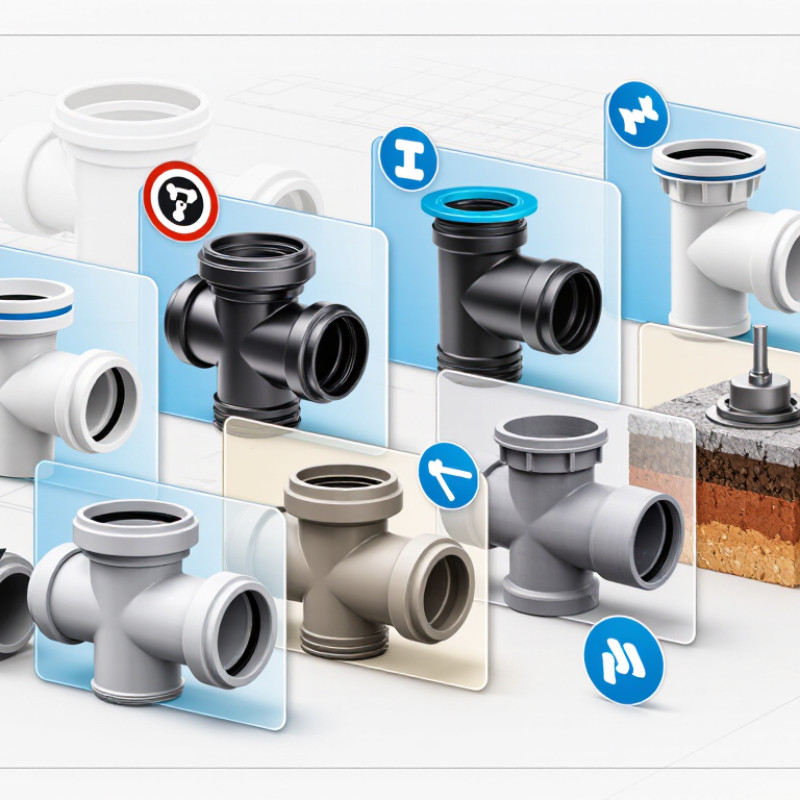
Sewer pipes are commonly classified by material, nominal diameter, and duty. PVC-U, polypropylene, and polyethylene are widely used for buried, non-pressure drainage; concrete is common for larger gravity sewers. EN 1401 covers PVC-U systems, while EN 1852 and EN 12666 address polypropylene and polyethylene drainage pipes. Material choice depends on soil conditions, installation loads, chemical exposure, and joint design—not price alone.
DN is a nominal size, not always the pipe’s exact internal diameter. Plastic systems may use DN/OD, referring to outside diameter; other systems can identify size by inside diameter. Check the applicable standard and product schedule before comparing sizes. A DN 300 pipe can therefore offer different flow capacity across materials and wall classes. Small detail. Yet important.
Application narrows the choice further: gravity sewers need suitable gradients and resistance to deformation, while rising mains require pressure-rated pipe and compatible joints. Stormwater lines may face sediment and intermittent high flows. The UN World Water Development Report 2017 estimated global wastewater generation at about 380 billion cubic metres annually, with projected growth of 24% by 2030. That figure signals infrastructure pressure, but it does not determine local pipe size. Buyers should verify hydraulic calculations, ground conditions, and inspection requirements; a tidy material chart cannot replace site data.
Sewer Drain Pipe Classification by Material, DN Size, and Application
The bars show indicative DN size ranges commonly encountered across sewer applications. PVC-U and PP are often used for building drainage and gravity sewers; PE/HDPE is used for gravity and pressure systems; concrete is common in larger gravity sewers; and ductile iron is used in pressure networks. Actual ranges vary by local standards, product availability, and project design.
China’s Key Drainage Standards: GB/T 5836.1-2018 and GB/T 12772-2016
For buyers comparing sewer and building-drainage pipes, two Chinese standards deserve close attention. GB/T 5836.1-2018 covers unplasticized polyvinyl chloride (PVC-U) pipes for building drainage. GB/T 12772-2016 covers cast-iron pipes and fittings for building drainage. They address different materials, so they are not interchangeable checklists.
Check the standard number and edition on each quotation, test report, and product marking. For PVC-U pipe, confirm dimensions, wall thickness, appearance, and the specified performance tests. For cast iron, review the pipe and fitting types, joint details, dimensions, and applicable test results.
Details matter. A socket that looks compatible on a drawing may not match the specified joint system on site.
Ask suppliers to identify the exact clauses used for inspection, and request traceable batch records where available. Compare documents against the project specification; a standard reference alone does not prove that every requirement has been met. Also confirm whether the project calls for additional requirements or a newer edition. One weak point in many purchasing schedules is vague wording such as “meets Chinese standards.” It leaves too much room for interpretation. Clear material, scope, edition, and test criteria make supplier comparisons more dependable.
China’s Top 10 Sewer Drain Pipe Manufacturers by Product and Market Focus
China’s top 10 sewer drain pipe manufacturers are best compared by product range and target market, not by a single ranking. Some focus on PVC-U pipes for residential drainage, where light weight and straightforward handling matter. Others specialize in HDPE systems for projects that need flexible pipe and welded joints. Concrete pipe producers often serve larger municipal networks, where diameter, load rating, and installation conditions shape the choice.
Look closely at the product details. Wall thickness, ring stiffness, joint design, and documented test results affect performance in the ground. A pipe that suits a small housing site may not fit a road crossing or a deep sewer trench.
Ask suppliers for technical sheets, sample specifications, and clear answers about production capacity. Small details matter.
Market focus also differs. Some manufacturers handle export orders and custom specifications; others concentrate on domestic infrastructure or regional distributors. Confirm the intended use, delivery terms, and quality checks before comparing prices. Catalogs can look convincing, but they rarely show every production limitation. A shortlist is only a starting point. Even a careful comparison leaves room for uncertainty, especially when project conditions are still changing.
Comparing Pipe Performance: SN4 and SN8 Ring Stiffness at 4 and 8 kN/m²
For sewer drain pipes, SN4 and SN8 describe nominal ring stiffness: 4 and 8 kN/m², respectively. Ring stiffness measures resistance to deformation when external pressure acts on a pipe. SN8 has twice the nominal stiffness of SN4, but that does not mean an installed sewer system can carry twice the load.
Picture a pipe buried beneath a garden path, with compacted soil pressing against its sides. SN4 may suit some low-load installations when the design and bedding conditions support it. Under a driveway, deeper cover, or less predictable soil, SN8 may offer a larger stiffness margin. It is not a substitute for good installation. Poorly compacted bedding can leave a pipe unsupported, even when its rating is higher.
Check the project depth, soil, groundwater, traffic exposure, and installation guidance before comparing quotations. Also confirm that the stated SN value follows the same test standard; figures can be difficult to compare across specifications. A higher class may increase material cost without solving the actual site risk. That judgment is easy to get wrong. Ask for the pipe’s technical data and verify that the proposed class matches the design conditions.
China Top 10 Sewer Drain Pipe Manufacturers for Buyers - Comparing Pipe Performance: SN4 and SN8 Ring Stiffness at 4 and 8 kN/m²
| No. |
Comparison Factor |
SN4 Pipe |
SN8 Pipe |
Buyer Consideration |
| 1 |
Nominal ring stiffness class |
SN4 |
SN8 |
SN indicates a nominal ring stiffness class; confirm the applicable product standard and specification for the pipe being quoted. |
| 2 |
Nominal ring stiffness |
4 kN/m² |
8 kN/m² |
SN8 has twice the nominal ring stiffness value of SN4. This comparison alone does not establish allowable burial depth or load capacity. |
| 3 |
Meaning of the class value |
Nominal stiffness class of 4 kN/m² |
Nominal stiffness class of 8 kN/m² |
Use the classification and tolerances defined by the relevant pipe standard; do not treat the class value as a complete design rating. |
| 4 |
Ring stiffness test |
Commonly determined using a ring-stiffness test method such as ISO 9969, where applicable to the product standard. |
Request the test method, test report, pipe dimensions and product-standard reference when comparing supplier data. |
| 5 |
Resistance to ring deformation |
Lower nominal stiffness class than SN8 |
Higher nominal stiffness class than SN4 |
Actual deformation under load also depends on pipe geometry, material, installation quality and surrounding soil support. |
| 6 |
Wall construction |
Wall thickness and structure depend on material, diameter and pipe design. |
Wall thickness and structure depend on material, diameter and pipe design. |
Do not infer wall thickness from SN class alone; compare the stated dimensions and construction for the same nominal size. |
| 7 |
Buried installation conditions |
Suitability must be checked against the project design conditions. |
Suitability must be checked against the project design conditions. |
Cover depth, trench width, bedding, backfill, soil properties and groundwater conditions all affect buried-pipe performance. |
| 8 |
Traffic and surface loading |
Class alone does not confirm suitability for a traffic-loaded installation. |
Class alone does not confirm suitability for a traffic-loaded installation. |
Evaluate traffic loads, cover, soil support and installation details together; SN8 should not be treated as an automatic traffic-load approval. |
| 9 |
Material and product standard |
The SN class may be used for applicable structured-wall or solid-wall plastic pipe products, depending on the governing standard. |
Confirm material, intended use, diameter series, joint system and the exact standard cited in the product documentation. |
| 10 |
Document checks before purchase |
Check the declared SN class, dimensions, test records and product identification. |
Ask for current certificates or test reports, dimensional data, joint compatibility details and project-specific design confirmation. |
Note: SN4 and SN8 refer to nominal ring stiffness classes of 4 kN/m² and 8 kN/m², respectively. The appropriate class for a project must be determined from the applicable standard and installation design, not from the SN value alone.
Buyer Checks: Compliance Tests, Production Capacity, Lead Time, and Export Support
When comparing China-based sewer drain pipe manufacturers, ask for test reports that match the pipe material, diameter, and intended use. Check which compliance standards apply in your destination market; requirements can differ. Request recent pressure, dimensional, and joint-performance results, with batch numbers that link the report to production records. Paper is not proof. Where possible, arrange an independent inspection or review the factory’s testing process during a visit.
Capacity needs evidence beyond a large workshop. Ask how many extrusion lines run, how many shifts are scheduled, and what monthly output remains available for your order. A sample may look sound, but production consistency matters more. Review defect records and confirm how rejected pipes are handled. Lead time should be broken into production, inspection, packing, and port delivery, with dates stated in writing. Allow a buffer. Resin supply or peak-season congestion can cause delays, and capacity figures may become outdated. Ask for updates at agreed milestones rather than relying on one promised ship date. Export support should include clear packing details, shipping documents, and a named contact who can answer technical questions. Even a careful check cannot remove every risk, but vague answers are useful warning signs.