Top NTC Temperature Probe Manufacturers and Suppliers
Choosing the right NTC Temperature Probe manufacturer requires more than comparing prices or browsing polished product pages. Probe accuracy depends on materials, thermistor quality, sealing methods, response time, and cable construction. These details matter in refrigerators, laboratory equipment, battery systems, HVAC units, and industrial controllers. A small sensing error can cause unstable temperature control, wasted energy, or premature component failure.
This guide examines top NTC Temperature Probe manufacturers and suppliers through practical purchasing criteria. It considers production experience, engineering capability, customization support, quality inspection, and documented testing procedures. Reliable suppliers should explain resistance values, B-value tolerance, operating ranges, insulation materials, and connector options clearly. They should also provide samples and traceable technical documents before large orders begin. Real-world performance matters.
Not every supplier deserves the same level of trust. A factory may advertise impressive accuracy while offering limited evidence. That deserves scrutiny. We therefore encourage readers to compare calibration data, response-time results, environmental testing, and after-sales support. Certifications can strengthen confidence, but they do not replace independent evaluation. Ask difficult questions early. Confirm the probe inside your actual assembly, not only on a datasheet.
The companies discussed here represent different strengths, including volume production, custom design, fast sampling, and application-specific support. Their suitability may vary by industry, budget, and required operating conditions. Some details can change over time. Supplier claims should be rechecked before purchase. A careful review can reduce technical surprises and support a more dependable sourcing decision.
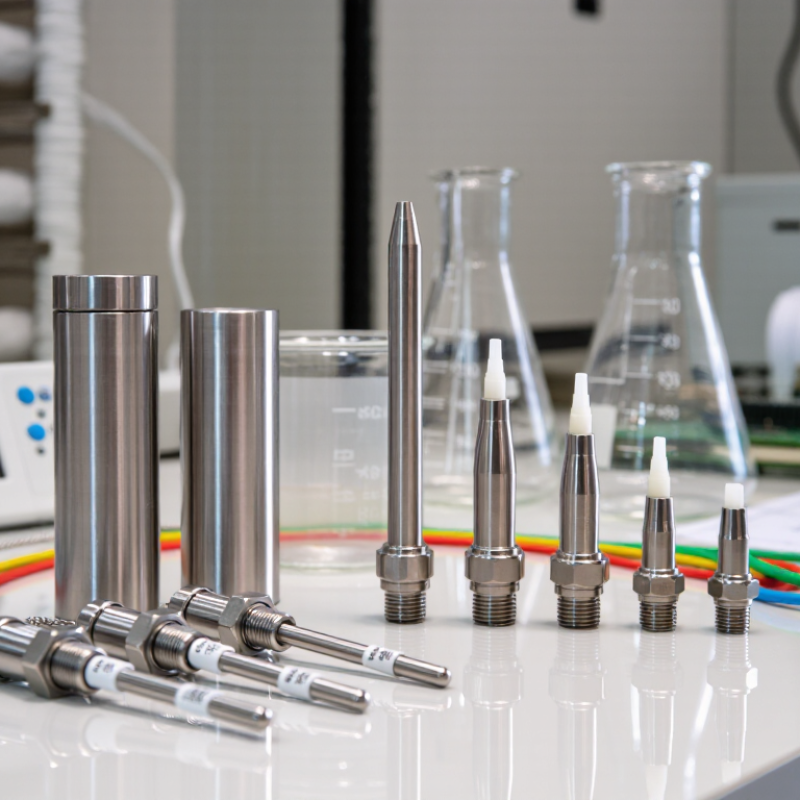
NTC Temperature Probes: Definition, Structure, and Operating Principles
An NTC temperature probe is a sensor that measures heat through electrical resistance. NTC means negative temperature coefficient. Its resistance falls as temperature rises. A measuring circuit detects this change and converts it into a temperature value.
Inside the probe, a small thermistor element forms the sensing core. It may use a bead, chip, or coated disc. Fine metal leads connect the element to insulated wires. Epoxy, ceramic, or a metal sheath protects it from moisture and physical stress. Some probes include a connector for fast installation. The outer sheath also affects response speed. Thick protection usually improves durability but slows heat transfer.
The operating principle is simple, but practical accuracy needs care. A controller often places the NTC in a voltage divider. It then calculates temperature from the measured voltage. The Steinhart–Hart equation can improve conversion across a wider range. Calibration remains important. Two probes with the same nominal resistance may still differ slightly. Real testing exposes this gap. Mounting pressure, airflow, and contact material can change readings. A probe is not magically precise. Engineers should check tolerance, response time, insulation, and long-term drift before selecting one. Even a well-built probe can report poorly when installed against a loose or poorly conducting surface.
Key Applications and Performance Requirements for NTC Probes
NTC temperature probes support accurate thermal control in HVAC units, battery packs, appliances, and laboratory equipment. Their resistance falls as temperature rises, allowing control systems to detect small thermal changes. Application conditions determine the required resistance value, B-constant, tolerance, and operating range. A probe near a battery cell may need fast response and strong insulation. A food appliance may require moisture resistance and stable readings during repeated heating cycles.
Performance depends on more than the sensing element. Probe housing, cable materials, connector quality, and sealing affect long-term reliability. Engineers should check response time in real conditions, not only in a supplier’s test chamber. Accuracy can drift after vibration, humidity exposure, or thousands of thermal cycles. This is where supplier experience matters. Ask for calibration data, inspection records, and evidence of batch consistency. No design is perfect. Small installation errors can still create large temperature differences.
Tips: Match the probe tip to the measured surface. Use thermal compound when appropriate. Keep sensing wires away from high-current cables. Confirm resistance at several reference temperatures before production. A practical trial can reveal problems that a specification sheet misses. Recheck the design after field testing, especially when airflow, mounting pressure, or cable length changes.
How to Evaluate NTC Temperature Probe Manufacturers and Suppliers
Evaluating NTC temperature probe manufacturers requires more than comparing prices. Start with measurement evidence. Ask for resistance-temperature curves, tolerance data, response-time results, and calibration records. A reliable supplier should explain testing conditions, not only provide a polished specification sheet. Verify whether probes meet relevant IEC requirements and whether production follows a documented quality system. ISO 9001 certification helps, but it does not replace sample testing. A 2024 MarketsandMarkets assessment projected temperature-sensor market growth above 6% annually, increasing pressure on suppliers to deliver stable, scalable production.
Tips: Request five to ten samples from one production batch. Test them at three temperatures, including your real operating limits. Check drift after thermal cycling, moisture exposure, vibration, and repeated bending. Compare the measured resistance values with the supplier’s curve. Small errors can become serious in medical, automotive, or industrial control equipment.
Supplier experience also matters. Review case studies, audit manufacturing capacity, and ask how rejected probes are handled. Traceability should reach the raw thermistor material, assembly date, and inspection record. Lead time deserves practical testing; a supplier may promise seven days, then require three weeks during peak demand. This happens. I have found that communication quality often predicts engineering support better than a sales presentation. Still, personal impressions are not enough. Use a written scorecard covering accuracy, stability, customization, documentation, warranty response, and total cost. A cheaper probe can become expensive after redesigns and field failures.
Top NTC Temperature Probe Manufacturers and Suppliers — How to Evaluate NTC Temperature Probe Manufacturers and Suppliers
Use the reference resistance curve below to compare supplier datasheets, temperature range, resistance tolerance, beta-value accuracy, response time, and calibration capability. The curve represents a standard 10 kΩ NTC thermistor at 25°C with a beta value of 3950 K, calculated from the Steinhart–Hart beta approximation.
A reliable supplier should provide measured resistance-versus-temperature data, defined accuracy limits, consistent interchangeability, traceable calibration, mechanical drawings, insulation specifications, and production quality-control documentation. The displayed values are theoretical nominal reference points and should be verified against each supplier’s test report.
Leading NTC Probe Manufacturers by Product Range and Industry Focus
Top NTC Temperature Probe Manufacturers and Suppliers
Leading NTC probe manufacturers differ by product range and industry focus. Some produce bead thermistors for compact electronics, while others build stainless-steel probes for industrial equipment. Medical and laboratory suppliers often emphasize traceable calibration, stable insulation, and small measurement tolerances. HVAC-focused manufacturers may offer threaded probes, cable assemblies, and fast-response sensors for air ducts or compressors. Product variety matters, but it does not prove technical strength.
In practical sourcing, examine the probe’s temperature range, resistance value, tolerance, response time, and housing material. A food-processing line may need a sealed probe that survives repeated cleaning. Battery systems may require low power consumption and flexible wiring. Ask for test records, dimensional drawings, aging data, and sample performance. I once treated a wide catalog as a quality signal. That assumption was weak. A supplier with fewer models may understand a specific industry better.
Tips: Compare samples under real operating conditions. Check readings near the lowest and highest expected temperatures. Inspect cable flexibility, connector fit, and sealing after thermal cycling. Confirm whether customization includes calibration, not only physical changes. Also review production consistency across batches. Small resistance shifts can affect control accuracy, especially in compact heating systems. Clear documentation is essential. So is responsive engineering support.