
Made in America
Get Connected With

Opening Hours M-F: 07:00 AM to 4:00 PM (PST)




Email Us
sale@abrvpartsacc.com
Call Us
+1 (626) 448-2100Made in America
Get Connected With
Opening Hours M-F: 07:00 AM to 4:00 PM (PST)
A secure entrance begins with a door that fits its setting, not merely a polished product photograph. An Entrance Front Door must handle daily use, changing weather, and the feel of the building around it. For buyers comparing manufacturers in China, details matter: the weight of a sample panel, the smoothness of a hinge, and the seal around the frame. Small flaws can become obvious after installation.
Architect Frank Lloyd Wright said, “The space within becomes the reality of the building.” His observation about architecture also speaks to the role of an entrance: it shapes the transition from outside to inside. This guide introduces leading Chinese manufacturers and the factors buyers can examine, including materials, customization, production capabilities, and after-sales support. “Top” is not a universal label. A supplier suited to a hotel project may not suit a private home, and a strong catalogue cannot replace clear specifications or careful sample checks. No supplier is perfect. Even so, asking about finish durability, hardware options, delivery planning, and quality inspection can make comparisons more grounded. The aim is practical: help readers identify manufacturers worth evaluating, while remembering that the right choice depends on the project, budget, and expectations.
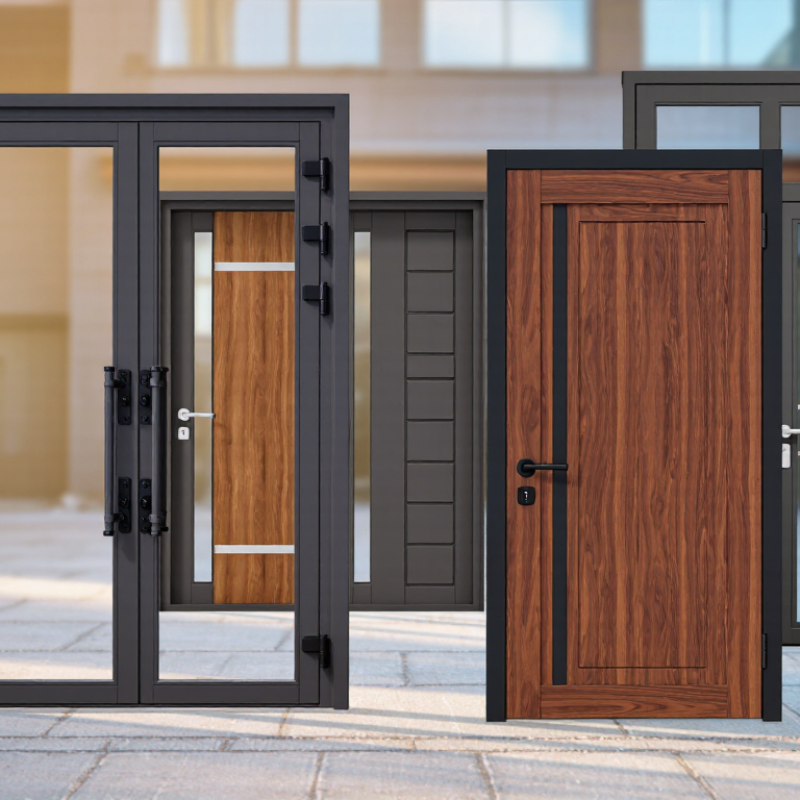
Top Entrance Front Door Manufacturers in China
Overview of China’s Entrance Front Door Manufacturing Industry
China’s entrance-front-door industry serves both new construction and renovation projects. Manufacturers produce steel, aluminum, timber, and composite doors, often tailoring dimensions, finishes, locks, and insulation to project needs. Quality depends on more than the door leaf. Frame alignment, hinge strength, continuous seals, and consistent coating thickness all affect installation and service life. Small tolerances matter.
Demand remains exposed to housing cycles. In its 2024 National Real Estate Market Basic Situation report, China’s National Bureau of Statistics recorded a 23.0% year-on-year fall in newly started building floor area, to 738.93 million square metres. Completed floor area fell 27.7%, to 737.43 million square metres. These figures do not measure door sales, but they indicate pressure on new-build orders and project schedules. Renovation demand may offset some of that pressure, though public statistics do not separately track entrance-door purchases.
For buyers, practical supplier checks include material specifications, dimensional inspection records, hardware compatibility, and sample testing under realistic use. Ask how the factory controls warping, finish variation, and damage during packing. Export experience alone does not prove long-term performance. Compare production records with finished samples, then confirm packaging and installation guidance. Supplier quality can vary; that deserves more attention than a polished catalogue.
| Industry Dimension | Industry Overview | What Buyers Should Verify |
|---|---|---|
| Product Categories | Manufacturers produce a range of residential entrance doors, including steel security doors, steel-and-wood doors, solid-wood doors, and aluminum-alloy doors. Product construction and performance vary by model. | Confirm the intended application, door configuration, opening direction, frame arrangement, and whether the quoted product is designed for interior or exterior exposure. |
| Materials and Construction | Steel products commonly use formed steel sheets and may include a core material for added rigidity, insulation, or sound reduction. Wood and aluminum products use different frame, panel, and finish systems. | Request material specifications for the leaf, frame, core, reinforcement, and hardware. Check that the specification describes the actual model being quoted. |
| Security Features | Depending on the model, security-related features may include reinforced door construction, multi-point locking arrangements, and anti-pry design details. Features differ across products and are not guaranteed by the product category alone. | Ask for model-specific test documentation and details of the lock, hinges, frame anchoring, and complete door-set performance. Compare complete assemblies rather than isolated hardware components. |
| Surface Finishes | Available finishes can include painted or powder-coated metal surfaces, decorative printed finishes, and wood coatings. Finish choices affect appearance and may influence maintenance requirements. | Confirm the finish type, color reference, sample approval process, care instructions, and suitability for the project’s climate and exposure conditions. |
| Customization | Many suppliers offer made-to-order options such as non-standard dimensions, panel designs, glazing, colors, hardware, and frame details. The scope of customization depends on the production process and order requirements. | Provide approved drawings and a written specification. Confirm measurement tolerances, permitted substitutions, sample sign-off, and responsibility for site measurement. |
| Fire-Rated Products | Fire doors are a distinct product category with performance requirements that depend on the applicable market and intended use. A standard entrance door should not be assumed to be fire-rated. | Where fire performance is required, verify the applicable local regulations and obtain valid evidence for the exact door configuration, including the leaf, frame, seals, glazing, and hardware. |
| Quality Control | Common quality checks may cover dimensions, appearance, opening and closing operation, hardware installation, and finish condition. Inspection methods and acceptance criteria vary by supplier and contract. | Agree on inspection criteria before production and request records for the finished order. For larger projects, consider independent pre-shipment inspection. |
| Export and Installation | Export orders require coordination of product specifications, protective packaging, shipping arrangements, and destination-market requirements. Installation conditions can affect the finished door’s operation and performance. | Confirm packaging, labeling, shipping documents, installation instructions, spare parts, and whether the supplier or buyer is responsible for delivery and installation support. |
| Supplier Evaluation | Supplier capabilities can differ in product range, engineering support, production capacity, customization, and export experience. No single product description establishes the performance of every manufacturer. | Compare recent references, factory and quality-management documentation, product-specific reports, approved samples, lead times, warranty terms, and the contractual specification. |