
Made in America
Get Connected With

Opening Hours M-F: 07:00 AM to 4:00 PM (PST)




Email Us
sale@abrvpartsacc.com
Call Us
+1 (626) 448-2100Made in America
Get Connected With
Opening Hours M-F: 07:00 AM to 4:00 PM (PST)
Automotive motor tester manufacturers serve a market shaped by electric vehicles, industrial production, and increasingly precise quality requirements. Their equipment can help engineers assess motor performance, insulation, vibration, temperature, and electrical characteristics. Yet a tester’s value depends on more than its feature list. It must suit the motor, test conditions, and production environment.
This overview introduces manufacturers from different regions and examines the capabilities buyers commonly compare. These include measurement accuracy, automation options, software integration, test speed, safety features, and technical support. A laboratory evaluating a prototype may need flexible measurements, while a production line may prioritize repeatability and cycle time. Different needs. Published specifications provide a useful starting point, but they cannot show every practical limitation. Buyers should verify performance against their own motors and workflows.
The manufacturers discussed here are not presented as a universal ranking. Product ranges, service coverage, and available configurations can change, so current details should be confirmed directly with suppliers. This guide aims to clarify what distinguishes one Automotive Motor Tester solution from another and which questions deserve attention before purchase. A comparison may look tidy on paper. Real testing is less tidy, and that is worth remembering. Experience with actual test samples, clear calibration practices, and responsive engineering support can help turn specifications into dependable results.
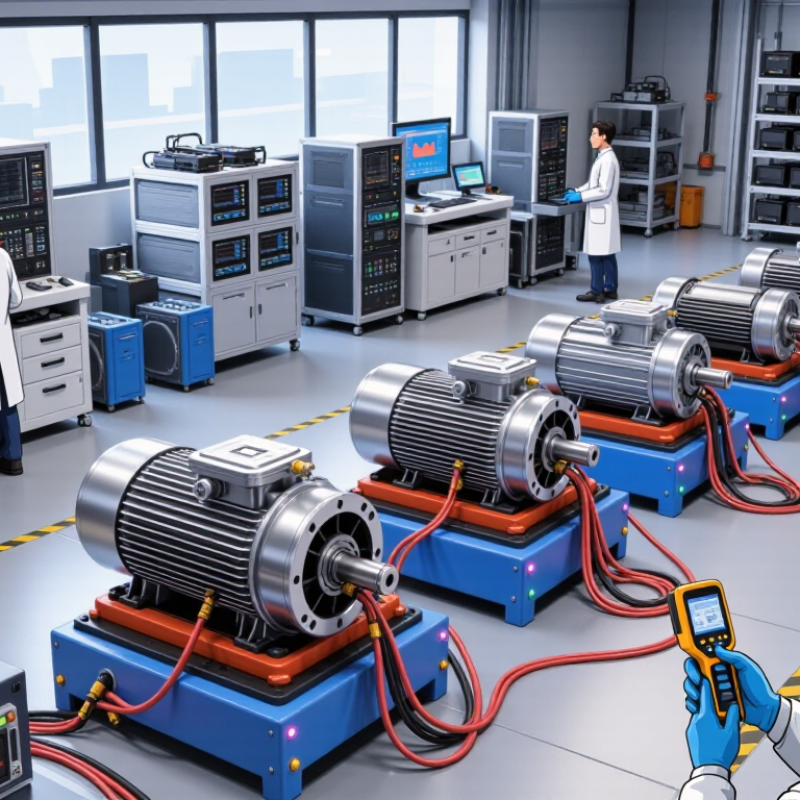
An automotive motor tester checks whether a motor delivers its expected performance under controlled conditions. It can measure speed, torque, voltage, current, power, and efficiency. Some systems also monitor vibration and temperature. On a test bench, a technician may connect the motor to a dynamometer, run it through different speeds, and compare measured output with target values. Small changes matter. A rising temperature or uneven vibration can signal a problem before it appears in vehicle use. Testers support development, production-line checks, and workshop diagnostics for traction motors, starter motors, and other vehicle actuators.
Demand for reliable motor testing is growing with vehicle electrification. The International Energy Agency’s Global EV Outlook 2024 reports that nearly 14 million electric cars were sold worldwide in 2023, representing about 18% of new car sales. That figure describes vehicle sales, not motor failure rates, but it shows why repeatable motor checks matter at scale. In production, testers can help identify output variation between units; in development, engineers can study how a motor responds to changing loads. A test result is only as useful as its setup. Sensor calibration, fixture alignment, and test conditions deserve attention. A clean trace is not proof. Human judgment still matters.
| Tester Category | Core Functions | Typical Recorded Data | Common Applications | Relevant Motor or Component |
|---|---|---|---|---|
| Winding Resistance Tester | Measures low electrical resistance in motor windings and checks phase-to-phase consistency. | Resistance by phase or winding, test current, ambient temperature, and temperature-corrected resistance when supported. | Incoming inspection, production checks, maintenance, and troubleshooting of winding connections or suspected conductor faults. | Traction motors, starter motors, alternators, and other wound electric motors. |
| Insulation Resistance Tester | Applies a specified DC test voltage to assess insulation resistance between conductors and between a winding and the motor frame. | Insulation resistance, applied test voltage, test duration, and temperature when recorded. | Insulation screening during manufacturing, servicing, and condition checks before equipment is returned to operation. | Motor windings, cables, and connected electrical assemblies, subject to the equipment manufacturer's test procedure. |
| High-Potential (Dielectric Withstand) Tester | Checks whether insulation withstands a prescribed electrical stress without breakdown or excessive leakage. | Test voltage, leakage current, test duration, and pass/fail result. | Production-line dielectric testing and verification of electrical insulation systems. | Motor windings and assemblies; test limits and procedures depend on the applicable product specification. |
| Surge Comparison Tester | Applies impulse pulses to windings and compares their response to identify differences that may indicate turn-to-turn insulation weaknesses. | Impulse voltage, waveform response, phase or coil comparison, and comparison result. | Winding quality control, fault diagnosis, and inspection after rewinding or repair. | Stator and armature windings in electric motors and generators. |
| Motor Dynamometer Test System | Loads a motor and measures its mechanical output alongside electrical input to evaluate performance across operating points. | Torque, rotational speed, mechanical power, voltage, current, input power, and efficiency where the system supports the required measurements. | Design validation, production testing, performance mapping, and comparison of motor operation under controlled loads. | Traction motors, starter motors, pumps, fans, and other automotive electric drives. |
| Back-EMF and Speed Test System | Measures generated voltage when a motor is rotated and relates electrical output to rotational speed. | Back electromotive force (back-EMF), rotational speed, phase balance, and waveform characteristics. | Manufacturing checks and diagnosis of winding or magnetic-field consistency. | Permanent-magnet motors and other motor designs that generate measurable back-EMF during rotation. |
| NVH Test System | Captures and analyzes noise, vibration, and harshness during motor operation. | Sound pressure or sound level, vibration amplitude, frequency spectrum, rotational speed, and test condition. | End-of-line quality checks, component development, and investigation of unwanted noise or vibration. | Traction motors, electric power steering motors, window-lift motors, and HVAC blower motors. |
| Environmental Motor Test System | Operates or evaluates a motor under controlled environmental conditions, such as temperature or humidity, when equipped for those tests. | Environmental condition, operating time, motor temperature, electrical readings, and observed performance changes. | Reliability evaluation and verification of motor operation under specified environmental test conditions. | Automotive motors and drive assemblies intended for use in demanding vehicle environments. |