
Made in America
Get Connected With

Opening Hours M-F: 07:00 AM to 4:00 PM (PST)




Email Us
sale@abrvpartsacc.com
Call Us
+1 (626) 448-2100Made in America
Get Connected With
Opening Hours M-F: 07:00 AM to 4:00 PM (PST)
Choosing the right Trackless Transfer Cart in 2026 starts with the work it must do, not the most impressive specification sheet. A cart carrying steel coils across a smooth factory floor faces different demands from one moving parts between crowded assembly stations. Load weight, travel distance, turning space, floor joints, ramps, and shift length all matter. Small details matter. A wheel that crosses a floor seam poorly can turn a routine trip into a jolt, repeated dozens of times each day.
Taiichi Ohno, the Toyota production-system engineer, is often associated with the principle, “Where there is no standard, there can be no improvement.” Applied here, it points to a practical first step: document today’s routes, loads, and delays before comparing designs. Then assess drive type, battery capacity, control options, safety features, charging time, and maintenance access against those real conditions. A higher payload rating alone does not guarantee a better fit. Nor does a sophisticated control system help if operators find it awkward to use. And, honestly, paper specifications can look more certain than they are. Ask suppliers to explain assumptions, share relevant operating references, and arrange a site-based trial when possible. This guide examines those trade-offs, including the questions worth asking before purchase. The best cart is not always the fastest or cheapest. It is the one that moves the required load reliably through your actual workplace, with a plan for upkeep and room to reassess.
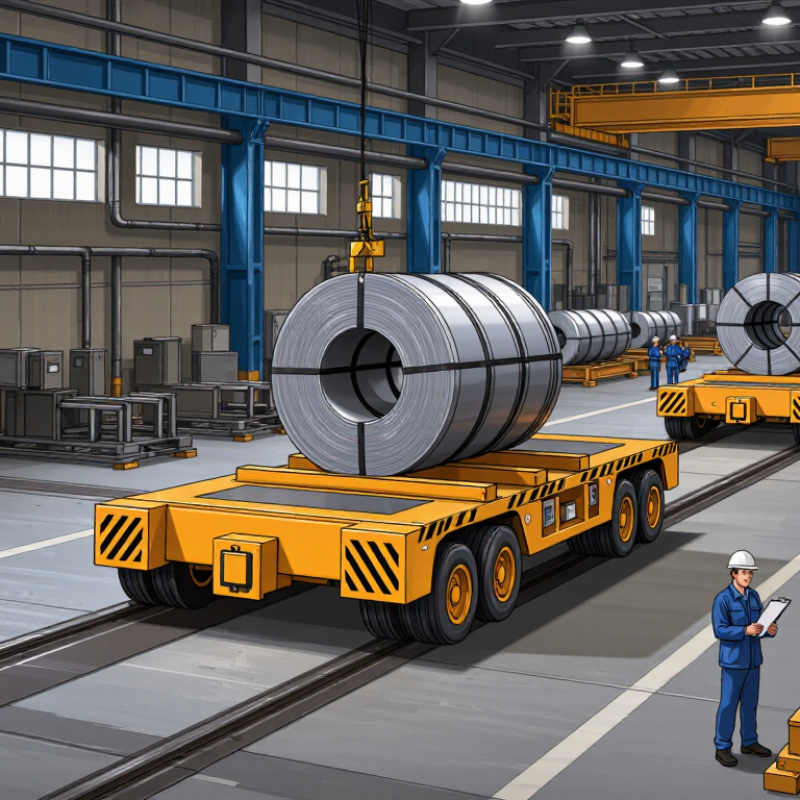
Trackless transfer carts move materials without fixed rails, using powered wheels and onboard controls. This lets them follow changing routes through factories, warehouses, and assembly areas. A cart might carry steel fixtures between workstations, or deliver bins of components along a marked aisle. It matters.
Their flexibility depends on the work environment. Check the payload, turning space, floor condition, travel distance, and number of daily trips. A heavily loaded cart may need more stopping distance, especially on dusty or uneven concrete. Narrow aisles can also make turning awkward. Measure the actual route, not just the distance shown on a floor plan.
Industrial uses range from moving molds and machine parts to transporting finished goods between production zones. Battery capacity, charging access, and control options affect how reliably a cart fits into a shift. Some sites use guided routes or designated crossing points to reduce conflicts with people and forklifts. That takes planning. A trackless cart is not automatically suitable for every layout; floor repairs, traffic patterns, and operator habits can change its performance. One detail is easy to overlook: the best route on paper may feel cramped when a full load is moving.
The figures and descriptions below are general selection guidance, not guaranteed specifications. Actual capacity, speed, runtime, and turning performance depend on the cart design, load distribution, floor condition, and operating environment.
| Cart configuration | Typical load range | Power and charging | Steering and maneuverability | Common industrial uses | Key selection considerations |
|---|---|---|---|---|---|
| Battery-powered, manually operated | Often used for light to medium loads; capacities vary widely by frame and drive system. | Rechargeable battery; charging plan should match shift length and travel distance. | Operator controls the route; suitable for flexible point-to-point movement. | Work-in-process delivery, tool transport, and short-distance material handling. | Check pedestrian traffic, stopping distance, operator visibility, and battery charging access. |
| Battery-powered, remote-controlled | Available across a broad range, from smaller loads to heavy industrial loads. | Rechargeable battery; battery chemistry, duty cycle, and charging method affect availability. | Remote operation can help the operator stand clear of the load; turning capability depends on the chassis. | Moving dies, coils, assemblies, and other loads where direct operator access is limited. | Assess remote-control range, emergency stops, communication reliability, and load stability. |
| Battery-powered, automated or guided | Designed to suit the payload and route; capacity is system-specific. | Battery charging or battery-management strategy is integrated with the operating schedule. | Follows a programmed route using a selected navigation and control system. | Repeated, predictable transfers between production cells, storage, and assembly areas. | Review route consistency, traffic separation, safety sensors, system integration, and recovery procedures. |
| Cable-reel-powered | Can be configured for substantial loads; capacity depends on the cart and application. | Receives power through a cable and reel; route and cable handling must be planned. | Suitable for a defined operating area; cable routing can limit free movement. | Fixed production routes and heavy-duty transfers with a nearby power supply. | Check cable travel length, floor crossings, reel maintenance, and protection from damage. |
| Diesel or other engine-powered | Often considered for heavy loads and outdoor or mixed-use environments. | Fuel-powered; requires refueling, engine maintenance, and suitable ventilation controls. | Route flexibility depends on vehicle layout, surface conditions, and turning design. | Outdoor yards, large industrial sites, and applications with limited charging access. | Consider emissions, noise, fuel storage, indoor-use restrictions, and local safety requirements. |
| Selection factor | What to measure or confirm | Why it matters |
|---|---|---|
| Payload and load center | Maximum load weight, dimensions, center of gravity, and how the load is secured. | Capacity must account for the actual load and its distribution, not weight alone. |
| Route and floor | Narrowest aisle, turning points, gradients, joints, floor condition, and indoor/outdoor sections. | The route affects maneuverability, traction, stability, and safe stopping. |
| Duty cycle | Trips per shift, distance per trip, operating hours, rest periods, and peak demand. | Helps determine power system, charging or refueling needs, and required availability. |
| People and traffic | Pedestrian crossings, shared vehicle lanes, visibility, warning devices, and emergency-stop access. | A safe operating plan must address interactions with people and other equipment. |
| Load interface | Deck dimensions, fixtures, lifting or loading method, restraints, and unloading height. | A suitable interface reduces shifting, handling steps, and damage risk. |
| Maintenance and support | Inspection access, tire and battery service, spare parts, operator training, and fault response. | Serviceability and a clear maintenance plan support dependable daily operation. |