How to Choose the Right Clay Graphite Crucible?
Choosing the right Clay Graphite Crucible begins with the metal, not the product photograph. Aluminium, copper alloys, brass, and precious metals create different chemical and thermal demands. A crucible that performs well with aluminium may deteriorate quickly with aggressive copper alloys. Temperature matters, but it is only one part of the decision.
John Campbell, a respected authority in casting technology, has stated, “The quality of the casting is determined by the quality of the metal.” His principle applies directly here. A clean melt needs a crucible with suitable chemical resistance, thermal stability, and mechanical strength. The selection should consider working temperature, batch size, furnace type, heating speed, flux exposure, and pouring frequency. Do not ignore wall thickness. It affects heat transfer, energy use, and service life.
Small details matter.
Check the crucible’s rated capacity under real operating conditions. Do not fill it to the rim. Leave practical space for expansion, dross, and safe handling. Inspect the surface before every melt. Hairline cracks, chipped rims, or unusual discoloration deserve attention. Preheating also requires care, because trapped moisture can cause sudden damage.
The “best” Clay Graphite Crucible is not always the most expensive model. It is the one that matches your process consistently. Still, this choice is rarely perfect on the first attempt. Records of melt temperature, cycle count, metal type, and failure patterns can reveal what catalog specifications cannot. That evidence supports a more reliable decision.
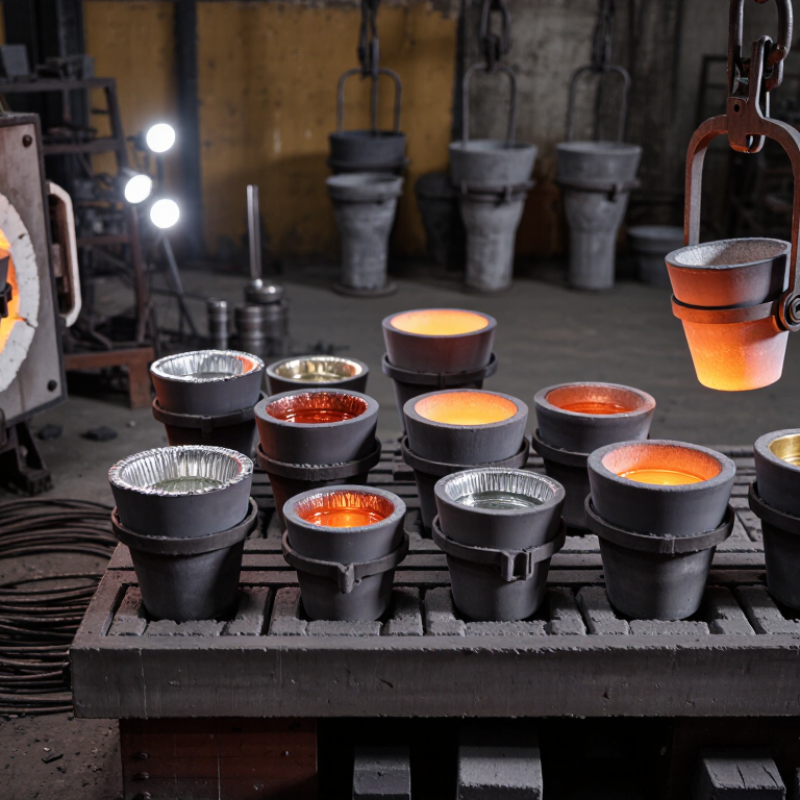
Define Alloy, Batch Size, and a 1,200–1,600°C Working-Temperature Range
Choosing a clay graphite crucible starts with the alloy, not the catalogue label. Aluminum melts near 660°C, copper near 1,085°C, and cast iron commonly requires 1,150–1,200°C. Steel may exceed 1,370°C. Add a safety margin, because furnace readings can differ from the metal temperature.
A 1,200–1,600°C working range covers many nonferrous alloys and selected ferrous applications. However, the upper limit is not automatic. Oxidation, flux chemistry, thermal shock, and repeated empty heating can shorten crucible life. A 20 kg batch also needs a different wall thickness and lifting method than a 2 kg batch. Leave headspace for stirring and alloy expansion. Small details matter.
Industry data reinforces the material choice. The USGS Mineral Commodity Summaries 2024 reported about 1.6 million metric tons of global natural graphite mine production in 2023. The IEA’s Global Critical Minerals Outlook 2024 also identifies graphite as a strategically important material for expanding energy technologies. Supply data does not replace testing, though. I would record alloy composition, charge weight, pouring temperature, hold time, and visible wear after every trial. My first estimate may be wrong. A crucible that survives one 1,500°C pour may still fail after ten cycles. Temperature range, batch size, and alloy chemistry must be evaluated together.
Select Capacity with 10–15% Freeboard for Safe Metal Expansion
How to Choose the Right Clay Graphite Crucible?
Select Capacity with 10–15% Freeboard for Safe Metal Expansion
Choosing a clay graphite crucible starts with usable capacity, not the largest number on a product sheet. A crucible should never be filled to its rim. Heated metal can expand, shift, and splash during lifting or furnace movement. I usually allow 10–15% freeboard above the planned metal charge. This space is a practical safety margin.
Measure the expected charge volume at room temperature, then check the alloy’s density and melting behavior. Capacity listed by weight can be misleading. A crucible rated for 50 kilograms may not suit every metal or furnace cycle. For example, if the charge occupies 18 liters, choose an internal capacity of roughly 20–21 liters. This keeps the metal below the upper edge while preserving room for movement.
Do not ignore charge shape. Large ingots, returns, and solid additions may sit unevenly before melting. The load can appear safe, then rise as smaller pieces settle. Foaming alloys may require more freeboard than quiet melts. I have seen operators select by weight alone, and that shortcut sometimes creates a cramped melt zone. It is worth rechecking furnace clearance, tongs, wall condition, and the actual filling level before heating. Keep the rim clean and inspect for cracks, deep erosion, or exposed graphite. Never add damp material. Small oversights can become serious problems near a hot furnace.
How to Choose the Right Clay Graphite Crucible? - Select Capacity with 10–15% Freeboard for Safe Metal Expansion
| Nominal Crucible Volume | Recommended Working Volume
(85% Fill) | Freeboard
(15%) | Aluminum Alloy
2.70 kg/L | Cast Iron
7.20 kg/L | Brass Alloy
8.50 kg/L | Copper
8.96 kg/L | Typical Use |
| 5 L | 4.25 L | 0.75 L | 11.5 kg | 30.6 kg | 36.1 kg | 38.1 kg | Small-batch melting and laboratory work |
| 10 L | 8.50 L | 1.50 L | 23.0 kg | 61.2 kg | 72.3 kg | 76.2 kg | General-purpose furnace batches |
| 20 L | 17.00 L | 3.00 L | 45.9 kg | 122.4 kg | 144.5 kg | 152.3 kg | Medium production melting |
| 30 L | 25.50 L | 4.50 L | 68.9 kg | 183.6 kg | 216.8 kg | 228.5 kg | Heavy-duty batch operations |
| 50 L | 42.50 L | 7.50 L | 114.8 kg | 306.0 kg | 361.3 kg | 381.0 kg | Large furnace melting systems |
Sizing Formula: Recommended metal charge = nominal crucible volume × 0.85 × metal density.
| Selection Factor | Practical Guidance |
| Freeboard | Keep 10–15% of the internal volume empty to reduce spill risk from metal movement, charging, and thermal expansion. |
| Metal Density | Use the actual alloy density whenever available. The values shown are representative room-temperature densities and are intended for preliminary sizing. |
| Temperature Compatibility | Aluminum melts at about 660°C, brass alloys commonly melt around 900–940°C, copper at about 1,085°C, and cast iron typically melts around 1,150–1,200°C. Confirm the crucible’s rated service temperature for the specific alloy and furnace. |
| Furnace Fit | Check the crucible’s outside diameter, height, pouring clearance, lifting equipment, and furnace opening before selecting the nominal capacity. |
| Charge Material | Allow additional space when using bulky scrap, ingots, or return material because charge shape can occupy more volume than the final liquid metal. |
Note: The charge masses are theoretical estimates based on 85% liquid fill. Actual operating capacity may be lower because of crucible geometry, alloy composition, furnace efficiency, slag, oxidation, and safe handling requirements.
Assess Oxidation Resistance and Recommended Preheating Procedures
How to Choose the Right Clay Graphite Crucible?
Oxidation resistance deserves more attention than maximum melting temperature. Graphite reacts with oxygen, especially during prolonged exposure above approximately 500°C. Higher temperatures accelerate surface loss. A crucible may look sound but become thinner after repeated firings.
Check graphite purity, clay bonding, apparent porosity, and any protective coating. ASTM C20 provides methods for measuring porosity, absorption, and bulk density in refractory materials. Lower open porosity generally limits oxygen penetration, but it does not guarantee long service. Testing matters.
Preheating should remove moisture gradually. Place the crucible in a cool furnace, then raise the temperature slowly to about 200°C. Hold it for 30 to 60 minutes. Continue toward 600°C at a controlled rate, preferably below 100°C per hour. Avoid direct flame contact and sudden charging of cold metal.
Keep the furnace atmosphere as neutral as practical. The U.S. Department of Energy reports that process heating represents about 51% of manufacturing energy use, making temperature control both technical and economical. After each cycle, inspect the rim, base, and inner wall. Weighing the crucible can reveal oxidation before visible damage appears.
There is no perfect schedule. Furnace loading, wall thickness, and local airflow change the result. A small trial batch is wiser than trusting a generic temperature chart. Insufficient preheating remains a common, avoidable mistake.
How to Choose the Right Clay Graphite Crucible?
A gradual preheating cycle helps remove moisture and volatile binders while reducing thermal shock. Graphite oxidation becomes increasingly significant in air above approximately 500°C, so high-temperature exposure should be brief and protected with a lid, inert atmosphere, or suitable furnace control.
The temperatures and holding times shown are practical guideline values for a gradual preheating sequence. Actual procedures should be adjusted for crucible size, wall thickness, furnace atmosphere, and the material supplier’s technical instructions.
Verify ASTM C20 Absorption Data and Manufacturer Heat-Cycle Ratings
How to Choose the Right Clay Graphite Crucible?
ASTM C20 absorption data deserves close attention. It can reveal how much moisture a refractory sample retains after testing. Lower absorption often suggests a denser structure, but it does not guarantee longer crucible life. Request the actual test report, not only a catalog percentage.
Check the sample identity, firing condition, test temperature, and reported apparent porosity. The crucible’s clay-to-graphite ratio also matters. A test piece may not perfectly represent production units. That limitation is easy to overlook.
Manufacturer heat-cycle ratings need equal scrutiny. Ask what one cycle means. Does it include preheating, melting, pouring, cooling, and inspection? Confirm the maximum temperature, heating rate, cooling rate, atmosphere, and metal charge used during testing.
A rating based on gentle laboratory heating may not match a furnace opening every twenty minutes. Look for data covering repeated cycles, thermal shock, oxidation, and flux exposure.
In practical evaluations, a crucible can survive its peak temperature yet crack during rapid cooling. That was an uncomfortable reminder for our selection process. Numbers alone were not enough.
Compare ASTM C20 results with heat-cycle evidence from similar operating conditions. Also record the crucible’s wall condition after each run, including hairline cracks, swelling, and graphite loss.