
Made in America
Get Connected With

Opening Hours M-F: 07:00 AM to 4:00 PM (PST)




Email Us
sale@abrvpartsacc.com
Call Us
+1 (626) 448-2100Made in America
Get Connected With
Opening Hours M-F: 07:00 AM to 4:00 PM (PST)
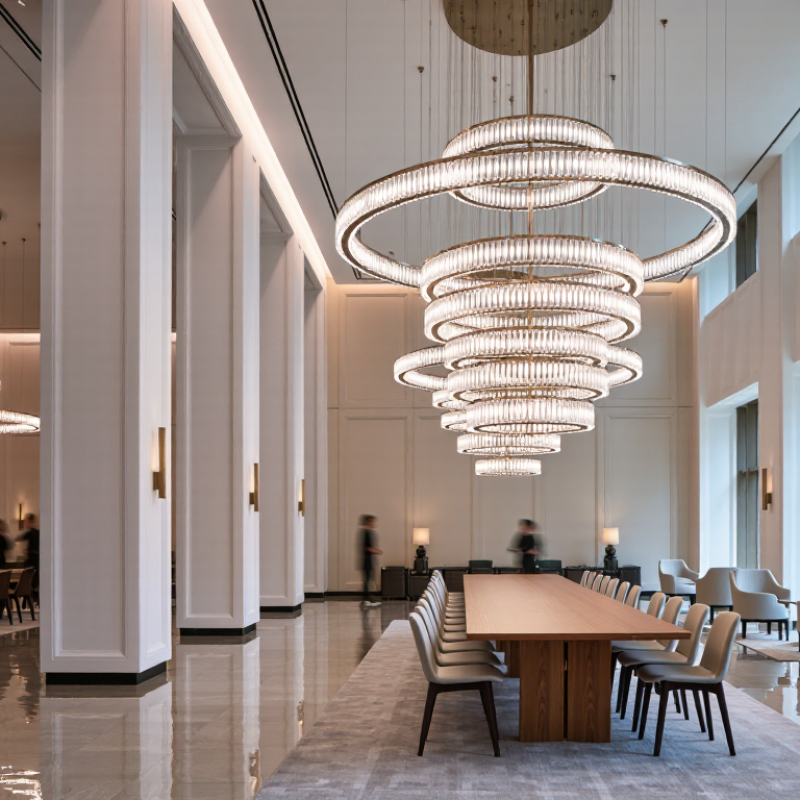
A chandelier can define a room before anyone notices its finishes. Yet for a project, appearance is only part of the decision. A Chandelier Led Lamp can combine decorative presence with efficient light, useful dimming options, and a longer service life than many traditional sources. The right choice still depends on the space. A dining table needs an even pool of light; a tall lobby may need stronger output and careful glare control. Small details matter.
For a practical perspective, fictional composite lighting consultant Elena Ward puts it this way: “Choose the chandelier for the room’s light, not just its silhouette.” Treat that as a guiding principle, not a verified quotation from a real specialist. Check lumen output, color temperature, dimmer compatibility, and the fixture’s dimensions before specifying a model. Ask how the light will fall across faces, tabletops, and nearby walls. Then review maintenance access and replacement options with the project team. A beautiful fixture can still disappoint if it creates harsh shadows or proves difficult to service. That part deserves a second look. In the sections ahead, we’ll explore how LED chandeliers can support project goals, where they may fall short, and what to compare before making a selection.
An LED chandelier lamp is a compact light source designed to fit a decorative fixture. Inside it, a semiconductor diode emits light when electric current passes through it. Many white LEDs use a blue diode and a phosphor coating to create warmer-looking light. A small component, a visible glow. The lamp’s driver converts household alternating current into controlled direct current, helping the LEDs operate steadily.
The driver and diode both matter. A poorly matched dimmer can cause flicker, while an unsuitable lamp may not fit the fixture’s socket or shade. Check the lamp’s base, dimensions, brightness, and dimmer compatibility before specifying it. In a dining room, for example, the bulbs should clear glass shades and provide even light across the table. Small details matter.
LEDs also produce less heat than incandescent lamps, but they still need suitable thermal design. The U.S. Department of Energy’s Energy Saver guidance reports that LEDs use at least 75% less energy and can last up to 25 times longer than incandescent lighting. These are broad comparisons, not guarantees for every chandelier lamp. Actual life depends on driver quality, operating temperature, and use. I would still check the product’s rated life and test a sample; published figures do not show how a particular fixture performs in a real room.
| Dimension | Typical LED Chandelier Lamp Information | What It Means for a Project |
|---|---|---|
| What the lamp is | A light source using light-emitting diodes (LEDs), supplied as a replaceable bulb or as an integrated LED module. | Check whether the fixture is designed for replaceable lamps or requires a complete integrated unit for servicing. |
| How it produces light | Electrical current passes through semiconductor diodes, producing light. Many white LEDs use a phosphor coating to convert some of the diode’s blue light into a broader white spectrum. | The LED converts electrical energy directly into light without using a heated filament. |
| Power conversion | An electronic driver regulates the current supplied to the LEDs. The driver is typically built into a replacement lamp or included within an integrated fixture. | Driver quality and compatibility can affect flicker, dimming performance, and service life. |
| Typical luminous efficacy | Many LED lamps fall within approximately 80–120 lumens per watt; actual performance varies by product, color quality, and operating conditions. | Compare lumens as well as watts to assess light output and energy use. |
| Typical color temperature | Common options include warm white around 2700–3000 K and neutral white around 3500–4000 K. Some lamps offer a wider selectable range. | Warm white is often selected for a welcoming decorative effect; neutral white can suit brighter, more task-oriented spaces. |
| Color rendering | Many general-purpose LED lamps have a color rendering index (CRI) of 80 or higher. Higher-CRI options, such as CRI 90 or above, are also available. | Higher CRI can help colors appear more natural, which may be important in hospitality, retail, and residential interiors. |
| Rated service life | Published ratings commonly range from about 15,000 to 50,000 hours, depending on the lamp and its test conditions. | Actual life can be reduced by heat, frequent switching, poor ventilation, or unsuitable dimmer and driver combinations. |
| Dimming | Some LED chandelier lamps are dimmable; others are not. Dimmable lamps may require a compatible LED-rated dimmer. | Verify compatibility among the lamp, driver, dimmer, and control system before installation. |
| Heat and installation | LEDs generally use less power than incandescent sources for similar light output, but they still generate heat at the diode and driver. | Follow the fixture’s ventilation and enclosed-lamp requirements to help maintain performance and service life. |
| Base and electrical fit | Chandelier lamps may use small screw bases such as E12 or E14, depending on the region and fixture. Supply voltage and lamp shape also vary. | Confirm the base, voltage, dimensions, and fixture specifications before selecting replacement lamps. |
Values are typical ranges for general guidance, not guarantees. Check the lamp and fixture specifications for exact performance, compatibility, and installation requirements.