
Made in America
Get Connected With



Deep Boring Machines form a specialized segment within the wider machine tool industry. They create precise, narrow holes through long metal components. Typical applications include hydraulic cylinders, oilfield parts, aerospace landing gear, and energy equipment.
The market deserves careful examination. Fortune Business Insights reported that the global machine tools market reached approximately USD 86.9 billion in 2023. Its forecast indicates continued growth through 2030. Grand View Research also identifies automation, computer numerical control, and advanced manufacturing as major development drivers. However, these reports rarely isolate Deep Boring Machine sales. That limitation matters. Supplier rankings should not rely on market size alone.
Joseph M. Juran, a leading manufacturing-quality authority, offered a relevant warning: “Quality does not happen by accident; it must be planned.” His principle applies directly to deep boring performance. Buyers should examine spindle stability, boring-bar support, coolant filtration, chip evacuation, dimensional accuracy, and after-sales service. A polished brochure proves little.
The strongest suppliers usually provide trial machining, inspection records, installation guidance, and documented tolerance results. A 12-meter workpiece can expose weaknesses that a small sample hides. This guide compares ten global suppliers through product capability, engineering experience, production scale, service coverage, and customer suitability.
Some rankings remain debatable. Public data is inconsistent across regions. Therefore, the list should support technical evaluation, not replace it. Before purchasing, manufacturers should request reference parts, verify achievable tolerances, and confirm local maintenance support. Price matters. Reliability matters more.
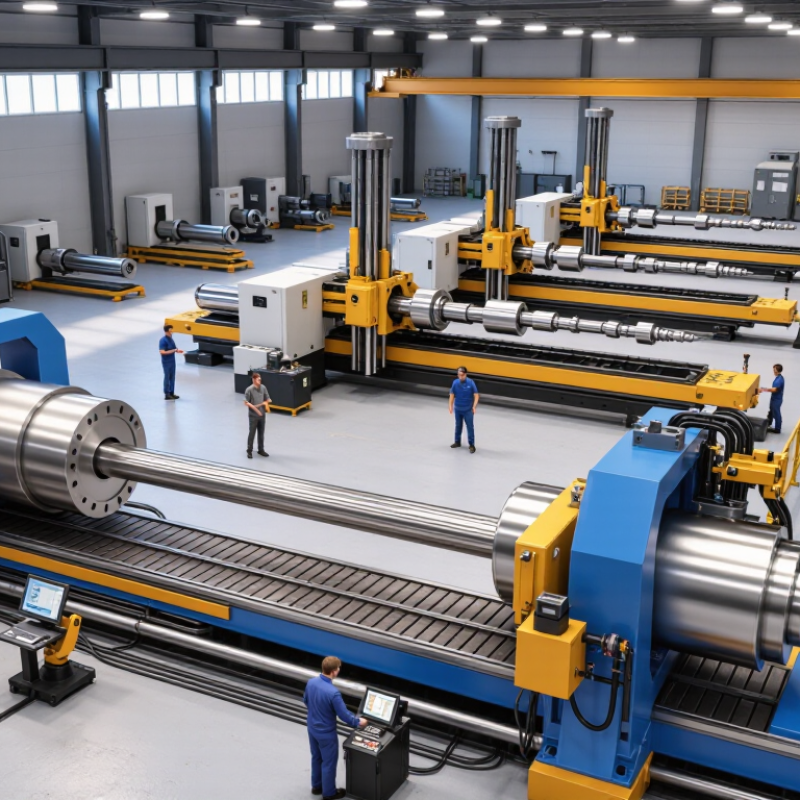
A deep boring machine creates or enlarges long, accurate internal holes in metal components. Unlike ordinary drilling, it controls tool alignment, chip removal, and bore geometry across unusual depths. A common benchmark is a depth-to-diameter ratio above 10:1, although the practical limit depends on material, tooling, and machine rigidity.
These machines typically use BTA, ejector, or single-tube systems. High-pressure cutting fluid carries chips away while supporting stable cutting. Operators check straightness, surface roughness, diameter tolerance, and thermal growth.
Accuracy matters. Hydraulic cylinders, injection molds, aerospace landing-gear parts, crankshafts, and energy equipment often require this process. A small alignment error can become significant near the bore’s end.
Demand is linked to broader manufacturing investment. Fortune Business Insights valued the global CNC machine tools market at approximately USD 81.95 billion in 2023 and projects about USD 128.41 billion by 2032. The International Federation of Robotics recorded 541,302 industrial robot installations worldwide in 2023, indicating stronger pressure for repeatable production. These figures cover wider sectors, not deep boring alone. That distinction matters.
When comparing suppliers, buyers should request test-bore records, tolerance data, coolant-pressure specifications, and service response times. Published capacity can look impressive, yet real performance may change with hardened steel, thin walls, or very long components. A machine that meets diameter targets may still produce unacceptable waviness. Suppliers should explain those limitations honestly.
10 Best Deep Boring Machine Suppliers Worldwide
Choosing among deep boring machine suppliers requires more than comparing prices. Practical experience shows that machine stability often matters more than impressive brochures. Examine spindle speed, boring diameter, cutting depth, vibration control, and achievable tolerance. Ask for sample machining results on materials similar to yours. A reliable supplier should provide clear drawings, inspection records, and documented acceptance tests.
Tips: Request a live machine demonstration. Check hole straightness, surface finish, coolant flow, and tool-change time. Speak with recent customers, not only listed references. Confirm installation support, operator training, spare-part availability, and response times across your region. Suppliers with experienced engineers can explain foundation requirements and process limits without making vague promises.
Technical authority should appear in the details. Look for traceable components, calibrated measuring equipment, safety documentation, and a realistic maintenance schedule. Compare warranty terms carefully, especially for control systems and precision assemblies. Worldwide delivery also requires practical planning for shipping, customs, voltage, and local service. A polished presentation can still hide weak after-sales support. My own evaluation approach would not be perfect; production conditions vary, and early assumptions can mislead. Run a supervised trial before signing a large order.
Objective evaluation framework based on machine capability, process suitability, quality control, service coverage, and documented compliance.
| No. | Evaluation Factor | Industry-Grounded Data or Benchmark | Evidence to Request from a Supplier | Why It Matters | Suggested Weight |
|---|---|---|---|---|---|
| 1 | Boring Process Compatibility | The machine should support the required process, such as gun drilling, BTA single-tube drilling, or ejector drilling. Process selection depends on bore diameter, depth-to-diameter ratio, material, and chip evacuation requirements. | Process description, tool-system specifications, sample parts, chip-control results, and application references for comparable materials. | A machine designed for the wrong deep-boring process can produce unstable cutting, poor chip evacuation, excessive tool wear, and unacceptable bore quality. | 15% |
| 2 | Bore Diameter and Drilling Depth | Capacity must cover the complete production range, including minimum and maximum bore diameter, maximum drilling depth, workpiece length, and depth-to-diameter ratio. Actual limits vary by machine configuration. | A dimensional capacity sheet showing bore range, drilling depth, workpiece envelope, spindle travel, and loading limits. | Nominal capacity alone is insufficient if the machine cannot process the longest, heaviest, or smallest-diameter production parts. | 14% |
| 3 | Accuracy and Surface-Finish Capability | Key acceptance characteristics include bore diameter tolerance, straightness, roundness, cylindricity, concentricity, and surface roughness. Required values must be defined by the part drawing and process plan. | Measured inspection reports from comparable parts, gauge details, calibration records, and documented acceptance criteria. | Deep bores can accumulate deviation over depth; verified process results are more reliable than catalog accuracy claims. | 14% |
| 4 | Machine Tool Accuracy Verification | Geometric accuracy and positioning performance should be verified using recognized machine-tool inspection practices, including applicable ISO 230 procedures or equivalent national standards. | Recent inspection reports, laser or ball-bar test results where applicable, compensation records, and a defined factory acceptance test. | Independent verification helps distinguish repeatable machine performance from unverified marketing specifications. | 10% |
| 5 | Spindle, Feed, and Coolant System | Suitable spindle speed, torque, feed force, coolant pressure, filtration, and flow are essential for stable deep-hole drilling. Required values depend on tool diameter, material, and cutting parameters. | Spindle torque curves, feed-force data, coolant pressure and flow specifications, filtration rating, tank capacity, and temperature-control options. | Insufficient torque, feed force, or coolant performance can cause tool deflection, overheating, premature tool failure, and poor hole quality. | 12% |
| 6 | Workholding and Part Handling | The system must safely support the workpiece throughout drilling. Important variables include chuck capacity, steady rests, fixture rigidity, maximum part mass, tailstock or support arrangements, and loading method. | Workholding drawings, maximum load data, fixture repeatability results, loading diagrams, and safety documentation. | Rigid, repeatable support reduces vibration, improves straightness, and protects operators and equipment during long drilling cycles. | 8% |
| 7 | Automation and Control Functions | Useful functions may include programmable feed control, tool-load monitoring, coolant monitoring, automatic chip management, probing, part measurement, recipe storage, and production data logging. | Control-system specification, available sensors, automation layout, software screenshots, cycle-time data, and integration interfaces. | Automation can improve consistency and reduce operator dependence, especially for repeat production and long unattended cycles. | 8% |
| 8 | Quality Management and Traceability | A documented quality-management system, commonly certified to ISO 9001, should cover design control, purchasing, production inspection, nonconformance handling, calibration, and corrective action. | Valid certificate, certificate scope, audit information, inspection plans, calibration records, and sample quality dossiers. | Traceability lowers commissioning risk and provides a structured response when machine or process issues occur. | 7% |
| 9 | Installation, Training, and After-Sales Support | Support should cover installation, alignment, operator training, preventive maintenance, spare parts, remote diagnostics, response times, and local or regional service availability. | Service-level agreement, response-time commitments, spare-parts list, training plan, escalation process, and installed-base references. | Downtime and commissioning delays can exceed the initial machine-price difference, making service capability a major ownership factor. | 7% |
| 10 | Total Cost, Delivery, and Compliance | Evaluation should include machine price, tooling, coolant equipment, installation, training, freight, duties, energy use, maintenance, spare parts, delivery schedule, safety requirements, and applicable electrical or regional regulations. | Itemized quotation, Incoterms, warranty terms, delivery milestones, utility requirements, risk assessment, safety declarations, and lifecycle-cost estimate. | A complete cost and compliance review prevents hidden expenses and reduces the risk of delays during installation, acceptance, or production launch. | 5% |
Recommended Supplier-Selection Method
Request identical technical proposals from each shortlisted supplier, score the documented evidence against the weighted factors above, and require a sample-part trial or factory acceptance test before final approval. All accuracy, tolerance, cycle-time, and service claims should be confirmed in writing.
Reference framework: ISO 230 machine-tool test practices, ISO 9001 quality-management principles, applicable machine-safety regulations, and the purchaser’s part drawings and process specifications. Technical values must be validated for the specific machine configuration and workpiece.
The 10 leading deep boring machine suppliers worldwide are being judged by more than production scale. Buyers need verified boring depth, spindle stability, coolant control, and after-sales response. Grand View Research reports that the global machine tools market was valued at approximately USD 86 billion in 2023, with steady growth expected through 2030. This expansion supports continued investment in high-precision boring equipment.
Performance details matter on the factory floor. A reliable supplier should provide test-boring records, dimensional inspection data, and clear tolerance limits. MarketsandMarkets identifies automation, digital monitoring, and improved process control as major machine-tool trends. These features can reduce setup errors and improve repeatability during long boring cycles. Still, specifications can look better than real output. Independent trials remain essential.
Regional service capacity also separates leading suppliers from ordinary exporters. Maintenance teams, spare-part availability, operator training, and installation support can affect total ownership cost more than the purchase price. The International Federation of Robotics reported over 500,000 industrial robots installed worldwide in 2023, showing stronger demand for connected manufacturing systems. Deep boring equipment should therefore communicate with plant monitoring systems where practical. Some suppliers may lack this capability. Buyers should ask difficult questions, inspect reference installations, and compare results under similar materials, hole diameters, and production volumes.
The strongest deep boring machine suppliers differ in technology, support, and industrial focus. One supplier may specialize in gun drilling systems for hydraulic components, while another builds BTA machines for long steel tubes. Advanced models often include CNC control, automatic tool monitoring, coolant filtration, and chip evacuation systems. These features matter when bore depth exceeds several meters. Accuracy is not guaranteed by software alone.
Several suppliers serve aerospace manufacturers with high-precision machines for landing gear, engine housings, and structural parts. Others focus on automotive production, producing equipment for crankshafts, transmission cases, and fuel system components. Heavy equipment manufacturers usually need rigid machines for hydraulic cylinders, mining parts, and large shafts. Medical manufacturers may require cleaner processes and tighter surface-finish control. Their service teams commonly provide installation, operator training, tooling advice, preventive maintenance, and remote diagnostics.
Some suppliers design compact systems for job shops, while others engineer complete production lines with loading robots and inspection stations. Custom fixtures are valuable when workpieces have unusual lengths or angled passages. Energy-sector customers often request machines for valves, heat exchangers, and turbine components. Marine and defense-related engineering may demand large work envelopes, yet project requirements vary widely. A supplier with broad claims may still lack local technicians or spare parts. Buyers should inspect test-boring records, calibration practices, response times, and training quality. Catalog photographs can mislead. Actual production trials reveal more.
Choosing among the 10 best deep boring machine suppliers worldwide requires more than comparing prices. Your project should define the shortlist. Measure the required boring diameter, workpiece length, hole depth, tolerance, and material hardness. Ask suppliers to explain spindle speed, feed control, coolant pressure, chip removal, and tooling limits. These details reveal practical engineering ability. An impressive brochure cannot replace a verified cutting test.
Request machine drawings, utility requirements, installation conditions, and realistic delivery milestones. Reliable suppliers provide inspection records, calibration certificates, and clear acceptance criteria. Look for evidence from comparable projects, not only generic testimonials. Contact two references. Ask about repeatability after months of production, operator training, spare parts, and remote troubleshooting. If service depends on one technician, risk increases. That point is easy to miss.
During evaluation, require a sample test using your actual material and target hole geometry. Record cycle time, surface finish, dimensional variation, tool wear, and coolant consumption. Compare the results with your production cost, floor space, and maintenance skills. The cheapest offer may become expensive after installation. I would also challenge vague promises about accuracy. Ask how accuracy is measured, where, and under which temperature conditions. Some uncertainty will remain. Document it before signing.